
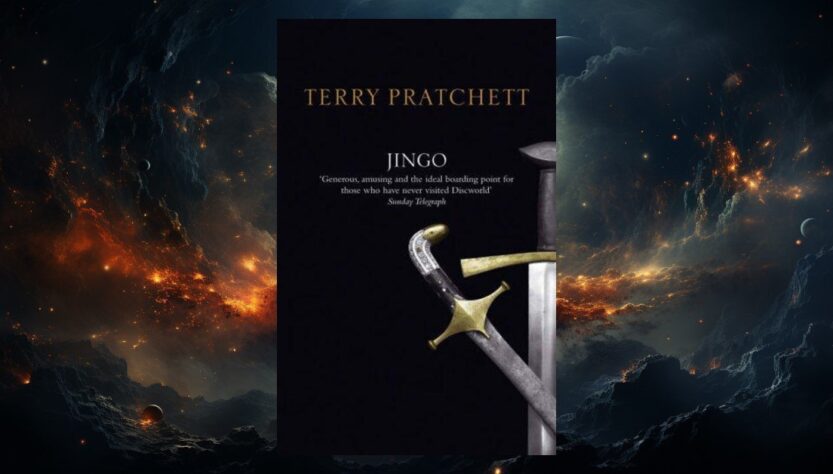
Review
Coming after Feet of Clay by Terry Pratchett, Jingo feels like the moment the City Watch books stop being merely excellent Discworld novels and become one of Pratchett’s most reliable ways of sneaking serious ideas past you while you are laughing. On the surface, this is the one with a mysteriously appeared island, a diplomatic incident, and two cities deciding they would quite like to go to war over a lump of strategically inconvenient rock. Under that, it is a very sharp book about nationalism, mob stupidity, political theatre, and the speed with which ordinary people can start chanting for blood if you give them a flag and a slogan.
What makes it work is that Pratchett never lets the satire drift off into abstraction. The whole thing is grounded through Vimes and the Watch, which means the book always has boots on cobbles, paperwork to dodge, and actual human consequences. Vimes is especially strong here. By this point Pratchett knows exactly what he has with him, a copper who understands institutions well enough to despise their worst instincts, but is still stubborn enough to do the job properly. Jingo gives him plenty to push against, and the result is one of those Discworld performances where the humour and the anger are doing the same job.
The Watch themselves are a big part of why this lands so well. Carrot remains fascinating because he is so obviously built like a king and yet insists on being a policeman. Nobby and Colon are, as ever, deeply silly, but never useless in the way lesser comic sidekicks would be. Angua gets good material, Vetinari is ice cold in exactly the right way, and Leonard of Quirm continues to be one of Pratchett’s best jokes, a genius whose imagination is permanently one step away from becoming a military disaster. There is also something very satisfying about how broad the Watch has become by this stage. It feels like a real institution now, scruffy, multilingual, argumentative, and much more representative of the city it is trying to police.
Because I have read well beyond this point in Discworld, it is easy to see Jingo as part of the run where Pratchett gets frighteningly confident. Guards! Guards! has the spark, Men at Arms expands the cast, and Feet of Clay gives the Watch real moral weight. Jingo takes all of that and scales it outward. The stakes are bigger, the satire is more openly political, and the book trusts its characters enough to let them carry that extra load. It is not my favourite Watch novel overall, later books like Night Watch hit even harder, but this is absolutely one of the entries that proves the strand has become something special.
If I have one mild reservation, it is that the middle stretch can feel slightly diffuse compared with the clean drive of Feet of Clay. Pratchett is juggling military farce, diplomatic nonsense, street level policing, a desert journey, and several different flavours of patriotic idiocy all at once. Most of the time that energy is a strength, because chaos is the point, but it does mean the book occasionally feels a touch baggier than the very best Discworld novels.
Still, when Pratchett is this locked in, even the looser bits are doing interesting work. The jokes are properly funny, especially when aimed at pompous men being idiots in uniforms, but there is real bite underneath them. Jingo is one of the books that best shows how good Pratchett was at writing about power without turning into a lecturer. He understood that war is often driven by vanity, tribalism, and people a long way from danger making speeches about honour. He also understood that the right way to attack that sort of nonsense is not always solemnity. Sometimes it is to make it look ridiculous, then quietly show the bill arriving afterwards.
Having read a lot of Discworld, I do not think Jingo is the single sharpest or most emotional book in the series, but it is one of the most assured. It is funny, angry, clever, and depressingly timeless. If the City Watch novels are where Discworld grows its steel, this is one of the books where you really feel the edge.
Rating: 4/5
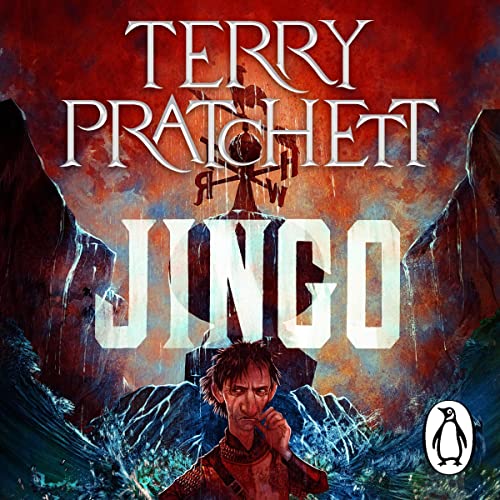
The Audible UK edition is narrated by Jon Culshaw, Peter Serafinowicz, and Bill Nighy and runs to 13 hours and 38 minutes.
Discover more from Unfolded Universe: Sci-Fi Book Reviews
Subscribe to get the latest posts sent to your email.